
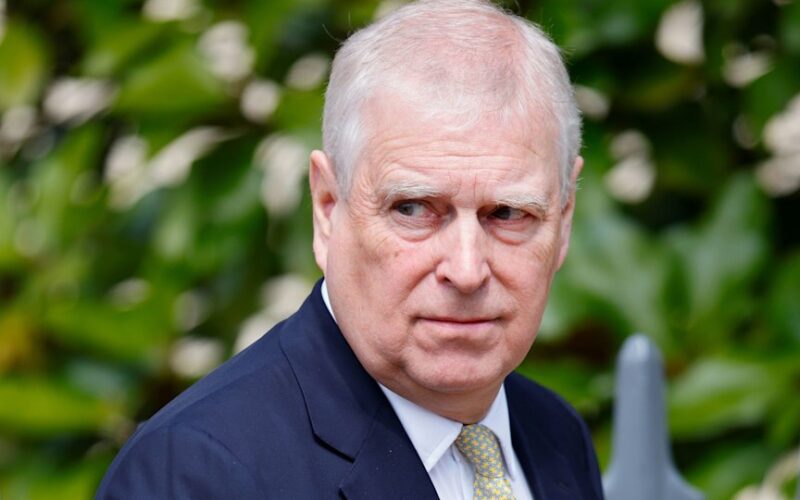
Andrew Mountbatten-Windsor, the former Duke of York and the younger brother of King Charles III, was arrested as suspicions arose of misconduct in public office. This is the first time in almost four centuries that a senior member of Britain’s royal family has been detained by police.
The arrest took place on Thursday morning at Wood Farm on the Sandringham estate in Norfolk as part of an investigation which delved into his past dealings with convicted sex offender Jeffrey Epstein. The arrest came on his 66th birthday and had been first confirmed in a police statement reported by TIME and Reuters.
Police are currently investigating allegations regarding Andrew sharing sensitive government information with Epstein during his time serving as the United Kingdom’s trade envoy from 2001 and 2011, according to reporting by Sky News.
Officers from several UK police agencies were involved in the operation. Investigators searched Wood Farm in Norfolk and Royal Lodge in Windsor which had been the former prince’s residence in the past, according to Reuters and The Guardian.
The inquiry follows the release of documents by the U.S. Department of Justice in relation to Epstein’s network. It is reported that the files contain emails which appear to show the former prince sharing reports from official visits to Hong Kong, Vietnam and Singapore, in addition to a confidential briefing on investment opportunities which have connections to reconstruction efforts in Helmand Province, Afghanistan, according to TIME.
Andrew has denied all wrongdoing, persisting in his claims that he had never witnessed or suspected any criminal behaviour by Epstein.
After nearly twelve hours of questioning, Andrew was photographed leaving Aylsham Police Station in Norfolk later the same day. The Guardian reported that he was released under investigation after being held for several hours.
The same day, a statement was issued in which King Charles III expressed his “deepest concern” about the arrest but affirmed “the law must take its course”, adding that authorities had the royal family’s “full and wholehearted support and cooperation.” The statement was widely reported by BBC News and other outlets, according to compiled reporting.
It is understood that Prince William and Catherine, Princess of Wales are in support of the King’s position. Reports also indicated Buckingham Palace had not received a warning in advance of the arrest, although the Home Office was informed shortly beforehand, according to The Guardian’s live coverage of the investigation.
Thames Valley Police gave confirmation of the detention of “a man in his sixties from Norfolk on suspicion of misconduct in public office,” adding that he had been released while investigations continue to take place. The Crown Prosecution Service claimed its lawyers had spoken with detectives but had not issued formal early investigative advice as of yet.
Under English law, misconduct in public office is a common law offence which involves the serious abuse or neglect of public authority and can lead to a maximum sentence of life imprisonment.
The arrest follows growing scrutiny of Andrew’s relationship with Epstein. He had been stripped of his royal titles months prior due to growing pressure over those connections, though he still remains eighth in the line of succession to the British throne.
The arrest provoked rapid reaction from the public. The family of Virginia Giuffre — who died by suicide in 2025 — stated the arrest demontrated how “no one is above the law.”
Maria Farmer, who was one of the first people to report Epstein, as well as his associate Ghislaine Maxwell to authorities, described the arrest as “the beginning of accountability and justice.”
On the other hand, Donald Trump described the situation as “a shame” and claimed it was “very sad for the Royal family,” according to multiple international media reports.
The case has also given rise to political debate across the Commonwealth about Andrew’s place in the line of succession. Mark Carney had recently called for his removal, calling the alleged actions “deplorable,” according to The Guardian and The Times.
Anthony Albanese and Christopher Luxon have also expressed their support for potential removal, both indicating that their governments would be in favour of such a move if pursued by the United Kingdom.
The British government has confirmed it is considering legislation for the removal of Andrew from the line of succession, which would permanently prevent him from ever becoming monarch.
Any removal would necessitate an Act of Parliament, approval from both the House of Commons and the House of Lords, as well as royal assent from King Charles III. Furthermore, it would require the agreement of the 14 Commonwealth realms where the monarch remains head of state.
The last time legislation removed someone from the line of succession was in 1936, when Edward VIII and his descendants were excluded following his abdication.
There has been no public comment from Buckingham Palace on the government’s consideration of legislation, and the police investigation remains ongoing.