
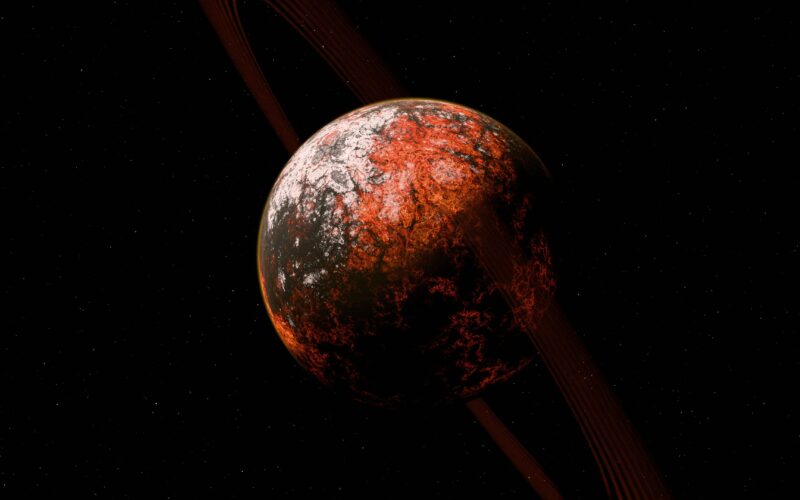
As you look into the night sky, you may believe that your knowledge of the solar system is sufficient. But it is about to be challenged. Astronomers made a breakthrough this week that is shaking everything scientists thought they knew about space.
There has been a long search for what has come to be known as “Planet Nine,” a theorised giant planet located beyond the Kuiper Belt. One of the key reasons that scientists believed Planet Nine existed was the observation of several clusters of asteroids known as Kuiper Belt objects behaving erratically.
Their peculiar orbital paths suggest that a giant planet may have been responsible for affecting their trajectories. However, a study conducted in June 2026 is about to turn this assumption upside down.
The Sednoid Spanner in the Works
It appears that the game-changing finding lies in the discovery of a so-called “sednoid,” an incredibly rare celestial object.
Rather than displaying a disturbed pattern of movement under the influence of gravity from a giant planet, this newly discovered celestial object exhibits a perfect, stable path of motion. Why is this important? That’s because this is the fourth sednoid observed to behave this way in the past several years.
If a massive planet were responsible for causing disturbances in the orbits of sednoids in the outer space, then none of them would display stability in their orbits.
Back to the Cosmic Drawing Board
What does this mean for the future of space exploration? It appears that astronomers are now facing one serious identity crisis.
- Is it further away? If Planet Nine does exist, it has to be thousands of times further from the Sun than we ever imagined to avoid affecting these stable objects.
- Is it a statistical illusion? Some scientists are now arguing that the “erratic” orbits we saw before were just a coincidence based on where our telescopes happened to be looking.
- Is it something else entirely? The anomalies in our outer solar system are real, but the culprit might not be a planet at all. It could be a collective ring of icy space dust, or a cosmic secret we haven’t even conceived yet.
While the discovery of another celestial body would have put the issue to rest once and for all, the latest revelations prove that the solar system still holds many secrets. And rather than putting this puzzle to bed, this discovery will only make astronomers continue searching for answers.