
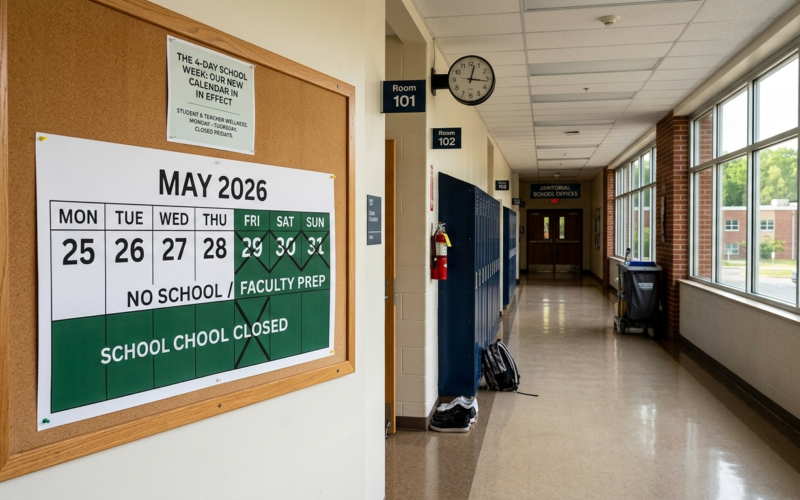
Indeed, there was a time when a five-day school week from Monday through Friday was the norm, the same as the regular ringing of the bell in a school at the start of first period. But from the previous 2025 academic school year to today’s school year 2026, a revolution has been quietly taking place in schools around the country. This is in response to the increasing teacher shortage and mental health break from school that is much needed now.
The New Weekend
Whereas the tactic started out as an effort to cut costs by saving fuel and electricity in the smallest of districts, it has now become a significant way for suburban districts to recruit teachers. By reducing the instructional schedule, schools are providing teachers with an incentive far greater than a small salary increase: they give them back their time. “The off day,” either a Monday or a Friday, has become the new time teachers can use to plan in depth or develop professionally without the danger of succumbing to the exhaustion that has been affecting teachers since the start of the pandemic.
The benefits of this adjustment for students, however, are not only an extended weekend but also less misbehavior and increased happiness at school, according to the latest research.
Trade-offs and Transitions
There are challenges in implementing this new system. Opponents cite the “childcare gap” faced by parents with jobs who have to seek childcare services on the fifth day. In addition, educational experts are also looking at how this affects students’ academic performance. While some research indicates that student performance will not be affected if teaching quality is maintained, there are also studies suggesting the possibility of a “learning lag” due to reduced hours spent in classrooms.
As a way to address these issues, some pioneering districts are experimenting with a “hybrid plus” approach. Rather than completely shutting down their schools, they utilize the additional day to offer optional programs such as vocational training, credit recovery, or community service programs.
The push towards a four-day week at school reflects an increasing change in society’s perception on education; instead of viewing the current “one size fits all” industrial model as the best solution, there is now a focus on well-being and practicality. With increasing numbers of states enacting laws to control these school weeks by 2026, it may not be too long before the traditional five days becomes an anomaly rather than a norm.