
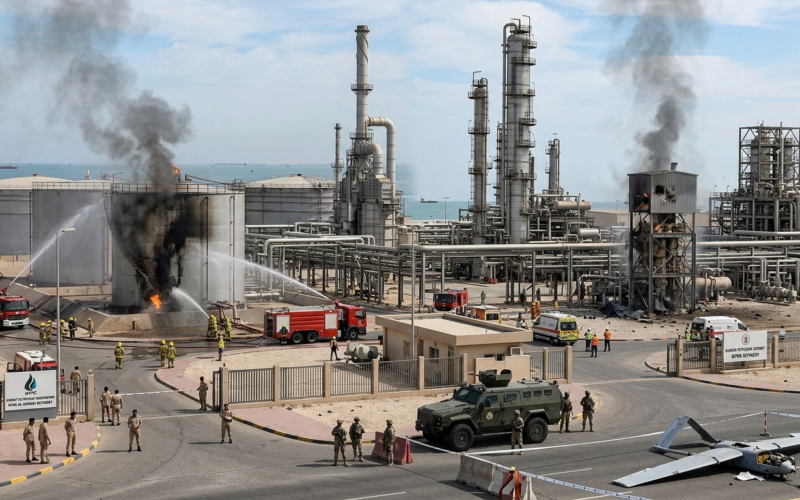
The escalation of the conflict involving Iran has reached a significant new peak as a series of overnight drone strikes targeted critical energy and infrastructure sites across Kuwait and Bahrain. According to reports from Argus Media, these strikes occurred in the early hours of Sunday as the broader regional war continues into its sixth week. The attacks have caused widespread material damage and forced the temporary shutdown of several key facilities, although no casualties have been reported by local authorities in either nation.
In Kuwait, the state-owned Kuwait Petroleum Corporation confirmed that its main headquarters and the national oil ministry building in the Shuwaikh district were struck by at least one drone. The Guardian reported that the strike ignited a large fire at the top of the complex, which is a central hub for the country’s energy administration. While the building had been evacuated prior to the impact and no injuries occurred, the Kuwaiti finance ministry described the resulting material losses as significant. Emergency teams worked throughout the morning to contain the blaze and secure the surrounding area.
Further strikes in Kuwait targeted the nation’s essential utility infrastructure. The ministry of electricity and water stated that two power and water desalination plants were hit by drones, leading to the emergency shutdown of two electricity generation units. This latest wave represents the third time in a single week that Kuwait’s power grid has been targeted. Argus Media noted that Kuwait relies heavily on eight major coastal plants for both electricity and freshwater, making these facilities particularly vulnerable to aerial aggression.
Simultaneously, the Bahraini national energy company, Bapco Energies, reported that a storage tank at one of its facilities was set ablaze following an Iranian drone attack. As detailed by The Guardian and the Qatar News Agency, the fire was successfully extinguished by mid-morning on Sunday after an immediate response from civil defense and specialized emergency teams. Bapco Energies confirmed that while the site sustained damage, the situation was brought into control without any reported injuries to staff or personnel at the storage complex.
The regional impact extended to other joint energy ventures as well. The Gulf Petrochemical Industries Company, which is a joint venture between Bahrain, Kuwait, and Saudi Arabia, announced that several of its operational units were also hit. According to reporting from the Qatar News Agency, the resulting fires at the petrochemical and fertilizer site were managed by on-site teams. Authorities in Bahrain have spent the day conducting detailed damage assessments to determine the long-term impact on production and export capabilities.
The broader context of these strikes reveals a growing strain on regional defense systems. The Guardian highlighted that the Bahraini defense force has intercepted hundreds of drones and missiles since late February, yet the volume of incoming threats has continued to challenge even the most advanced air defense networks. This overnight surge in activity follows similar reported incidents in the United Arab Emirates and Iraq, suggesting a coordinated effort to disrupt the energy and economic stability of the Gulf states.
As the conflict intensifies, the reliance on desalination and power infrastructure has emerged as a primary strategic concern for the affected nations. The Jerusalem Post observed that the Gulf states have become a frontline in the ongoing war, facing thousands of threats over the last month alone. While many of these attacks are successfully neutralized, the material damage caused by those that penetrate defenses is creating an increasingly complex humanitarian and economic landscape for the region.
Government officials in both Kuwait and Bahrain have urged residents to remain calm and follow safety protocols as sirens continue to sound in response to ongoing threats. The international community is monitoring the situation closely, as the disruption to energy production in the Gulf typically has immediate repercussions for global markets. For now, the focus remains on the restoration of essential services and the assessment of the significant infrastructure damage caused during this latest overnight escalation.