London saw one of its largest policing operations in recent years on May 16, 2026, as tens of thousands of people gathered across the capital for two opposing demonstrations, prompting widespread security measures, road closures, and heavy police presence amid fears of disorder.
The Metropolitan Police deployed around 4,000 officers, supported by mounted units, dogs, drones, helicopters, armoured vehicles, and live facial recognition technology in an effort to manage simultaneous protests and prevent clashes. The scale of the operation was described by officials as “unprecedented in recent years,” with authorities warning that the day would be one of the busiest for public order policing in modern London.
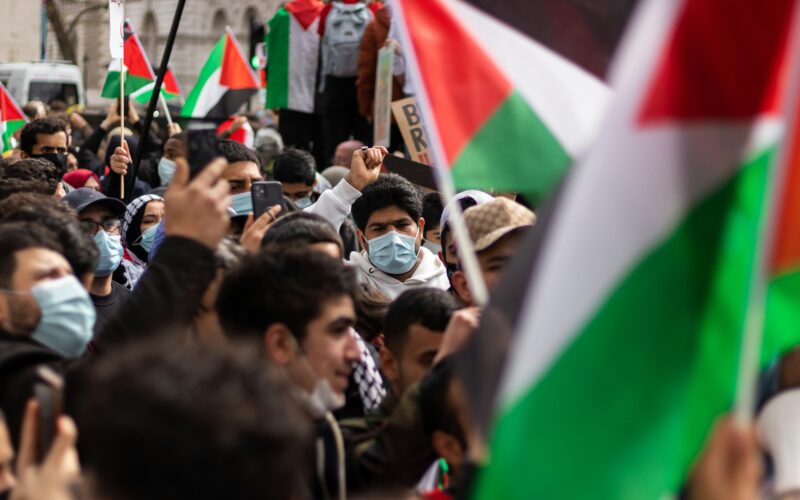
According to reporting from The Guardian, Reuters, the Associated Press, Sky News, and The Financial Times, the protests centred around two major events: the far-right “Unite the Kingdom” rally led by activist Stephen Yaxley-Lennon, known as Tommy Robinson, and a pro-Palestinian march marking Nakba Day, which commemorates the displacement of Palestinians in 1948.
The Metropolitan Police said the protests were expected to draw between 80,000 and over 100,000 participants combined, with estimates varying across agencies. Some reports suggested the far-right rally alone could attract around 50,000 people, while the Nakba Day march could bring tens of thousands more into central London.
Authorities also warned that the timing of the protests, which coincided with the FA Cup final at Wembley Stadium between Chelsea and Manchester City, increased the risk of public disorder, particularly as football fans were expected to travel through central London during the day. Police expressed concern that some supporters might join or pass through protest routes after the match.
According to The Associated Press and Reuters, police established strict separation zones between the two protest groups to reduce the risk of confrontation. Officers were deployed along key routes in Westminster, Whitehall, and surrounding areas, with barriers installed to keep opposing marches apart.
Officials also took the unusual step of using live facial recognition technology in a public order operation for the first time in this context, positioning cameras in areas such as Camden to identify individuals flagged in connection with previous unrest or known security risks. The Metropolitan Police said the technology was part of a wider strategy to prevent violence and identify offenders in real time.
Ahead of the demonstrations, the UK government barred 11 foreign nationals from entering the country due to concerns about extremist activity linked to the far-right rally. Prime Minister Keir Starmer and Home Office officials stated that the measures were intended to prevent hate speech and protect public order. According to Reuters and The Financial Times, the banned individuals included activists with histories of inflammatory anti-immigration rhetoric.
Political leaders strongly criticised the tone of the far-right demonstration. Starmer described the rally as promoting “hatred and division,” while also stressing the importance of protecting the right to peaceful protest. Meanwhile, community groups and religious leaders called for calm and urged restraint, warning that rising tensions risked inflaming divisions within already strained communities.
The Nakba Day march, organised by pro-Palestinian and anti-war groups, proceeded under strict police conditions. Organisers said the demonstration was intended to highlight historical displacement and ongoing humanitarian concerns in Gaza and the wider Middle East conflict. However, authorities monitored the event closely amid concerns about potential hate speech or escalation linked to broader geopolitical tensions.
Both marches have been part of a growing pattern of large-scale demonstrations in London over recent years, particularly surrounding immigration, identity politics, and international conflicts. According to Sky News, previous “Unite the Kingdom” rallies have drawn large crowds and, in some cases, resulted in clashes with police and arrests, prompting heightened preparation this time.
Police commanders emphasised that their priority was preventing violence while allowing lawful protest to proceed. Deputy Assistant Commissioner James Harman said officers were prepared for “a highly complex and fast-moving operation,” involving coordination across multiple agencies and contingency planning for rapid deployment.
Throughout the day, London’s transport network experienced disruption, with road closures affecting central routes and increased security checks at key stations. Residents and visitors were advised to expect delays as officers maintained a visible presence across major intersections and public spaces.
Despite heightened tensions, officials later reported that the large-scale policing strategy helped prevent major outbreaks of violence, though isolated incidents and arrests were still being investigated. Authorities said further analysis would be conducted into protest behaviour, policing tactics, and the effectiveness of facial recognition deployment.
The day ultimately highlighted the growing challenge faced by UK authorities in managing politically charged demonstrations in densely populated urban environments, particularly when multiple large-scale events coincide in a single city.
Information in this article was compiled and rewritten from reporting by The Guardian, Reuters, Associated Press, Sky News, and The Financial Times.