
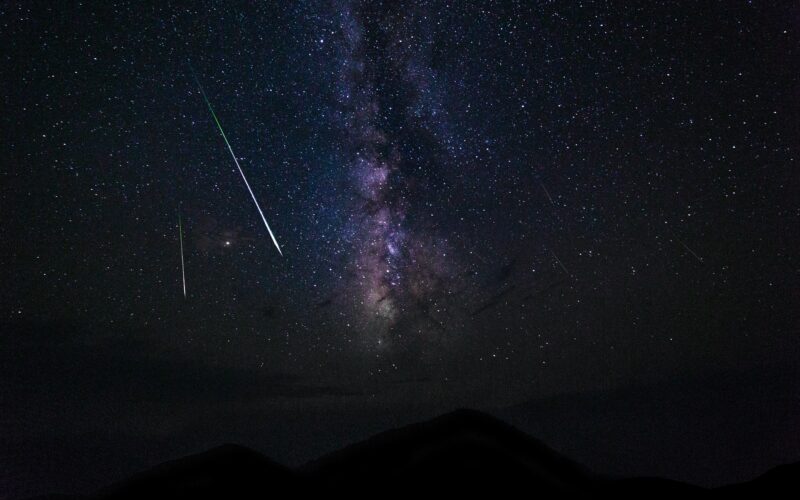
The annual Lyrid meteor shower has once again drawn global attention, with stargazers across Europe, North America, and beyond turning their eyes to the night sky to witness one of the oldest recorded celestial events. Covered widely by news outlets including The Guardian, Live Science, and The Times, this year’s display combined favourable viewing conditions with the enduring fascination of a meteor shower that has been observed for more than two millennia.
According to The Guardian, the Lyrid meteor shower reached its peak during the night of 22 April into the early hours of 23 April 2026, offering observers the chance to see bright, fast-moving meteors streak across the sky. The meteors appear to radiate from the constellation Lyra, near the bright star Vega, and are best viewed after midnight when the radiant point rises higher in the sky. The publication noted that the Lyrids typically produce around 10 to 18 meteors per hour, many of which leave distinctive glowing trails behind them.
Coverage from Live Science emphasised the particularly favourable conditions for viewing in 2026. With a relatively dark sky due to minimal moonlight, observers in the Northern Hemisphere were able to enjoy clearer visibility than in some previous years. The outlet reported that peak activity could reach between 10 and 20 meteors per hour, with the best viewing times occurring in the predawn hours when the sky is darkest and the radiant point is highest.
Meanwhile, The Times highlighted the global appeal of the event, noting that the meteor shower is visible across multiple continents and remains a major draw for both amateur astronomers and casual skywatchers. Although the average rate is lower than more famous showers such as the Perseids, the Lyrids are known for producing occasional bursts of intense activity, sometimes reaching up to 100 meteors per hour in rare cases. The paper also pointed out that the shower is caused by debris from Comet Thatcher, which last passed near Earth in 1861 and will not return for centuries.
The origins of the Lyrid meteor shower contribute significantly to its enduring scientific and cultural interest. As Earth passes through the trail of dust and debris left behind by Comet Thatcher, tiny particles enter the atmosphere at high speed and burn up, creating the bright streaks commonly referred to as “shooting stars.” This phenomenon has been documented for over 2,700 years, making it one of the longest continuously observed meteor showers in human history.
In addition to its historical significance, the Lyrids are known for their distinctive visual characteristics. Many of the meteors are described as fast and bright, sometimes producing “fireballs”—particularly luminous meteors that can briefly outshine surrounding stars. These features, combined with their occasional smoky trails, make the Lyrids a visually striking event despite their relatively modest hourly rate compared to other meteor showers.
Reports across the three outlets also highlighted practical advice for viewers hoping to catch the spectacle. All emphasised the importance of finding a location away from urban light pollution, allowing the eyes time to adjust to the darkness, and avoiding the use of bright screens. Unlike some astronomical observations, no special equipment is required to view the Lyrids, making the event widely accessible to the public.
The global response to the 2026 Lyrid meteor shower reflects a broader public interest in accessible astronomical events. Social media platforms have been filled with images and videos of the display, while astronomy groups and observatories have encouraged people to engage with the night sky. The widespread visibility of the Lyrids, particularly in the Northern Hemisphere, has made it a shared experience across different regions and cultures.
At the same time, the event underscores the continuing role of natural phenomena in capturing public imagination in an increasingly technology-driven world. While space exploration and satellite technology often dominate headlines, events like the Lyrid meteor shower offer a reminder of the simpler, observable wonders of the universe that require nothing more than a clear sky and a bit of patience.
Looking ahead, astronomers note that the Lyrids are just one of several major meteor showers visible each year, with others such as the Perseids and Geminids expected later in 2026. However, the Lyrids’ combination of historical significance, striking visual effects, and accessibility ensures that they remain a highlight of the astronomical calendar.
By drawing on reporting from The Guardian, Live Science, and The Times, this year’s coverage illustrates how a recurring natural event can still generate widespread excitement and engagement. As millions of people around the world paused to watch the skies, the 2026 Lyrid meteor shower once again demonstrated the enduring appeal of the cosmos and humanity’s long-standing fascination with the stars.