
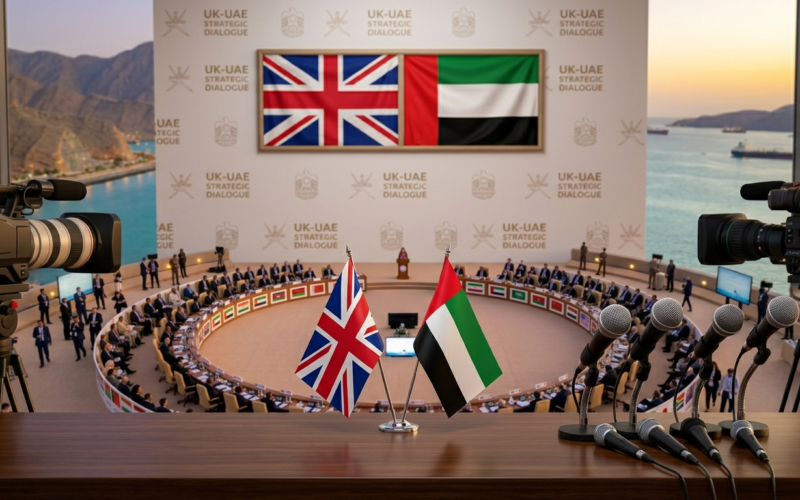
ABU DHABI – The United Arab Emirates and the United Kingdom have formally condemned Iran’s recent military actions against the UAE and other Gulf states, calling the strikes “egregious and unjustifiable” violations of international law.
The joint statement was issued following a high-level diplomatic meeting in Abu Dhabi on April 18 between H.H. Sheikh Abdullah bin Zayed Al Nahyan, UAE Deputy Prime Minister and Minister of Foreign Affairs, and Rt Hon Yvette Cooper MP, the UK Secretary of State for Foreign, Commonwealth and Development Affairs.
The meeting marked Cooper’s first official visit to the UAE, building on previous discussions between UK Prime Minister Sir Keir Starmer and UAE President Sheikh Mohamed bin Zayed Al Nahyan on April 9.
Condemnation of Iranian Aggression
In their joint statement, the two ministers “condemned in the strongest terms Iran’s egregious and unjustifiable attacks on the UAE and States across the region.”
According to the joint communique, these attacks specifically targeted civilians and civilian infrastructure, which the ministers described as being “in clear breach of their sovereignty and territorial integrity and in flagrant violation of fundamental principles and rules of international law, including the UN Charter.”
The strong diplomatic rebuke comes amid heightened regional tensions, with the UK minister extending gratitude to UAE authorities for their “extensive efforts to safeguard British Nationals amid recent regional hostilities.”
Strategic ‘Framework’ for Cooperation
Beyond the immediate security concerns, the two nations formalized a broad Framework for enhanced cooperation aimed at solidifying a long-term bilateral partnership.
The framework covers several strategic sectors, including:
- Foreign affairs and defence
- Trade and investment
- Artificial Intelligence (AI)
- Energy transition
- Judicial cooperation and combating illicit finance.
Maritime Security and the Strait of Hormuz
A significant portion of the condemnation focused on threats to international shipping routes.
Recalling UN Security Council resolution 2817 (2026), the ministers condemned Iran’s actions and threats aimed at closing or obstructing international navigation through the Strait of Hormuz.
They affirmed the importance of freedom of navigation in accordance with the UN Convention on the Law of the Sea (UNCLOS). The two sides further referenced a March 19, 2026, decision by the International Maritime Organization (IMO) Council, which condemned Iran’s threats against vessels as a “grave danger to life and serious risk to the safety of navigation.”
The ministers welcomed a recent initiative by the UK and France, announced on April 17, to support freedom of navigation and protect global economic stability with the support of an international coalition.