
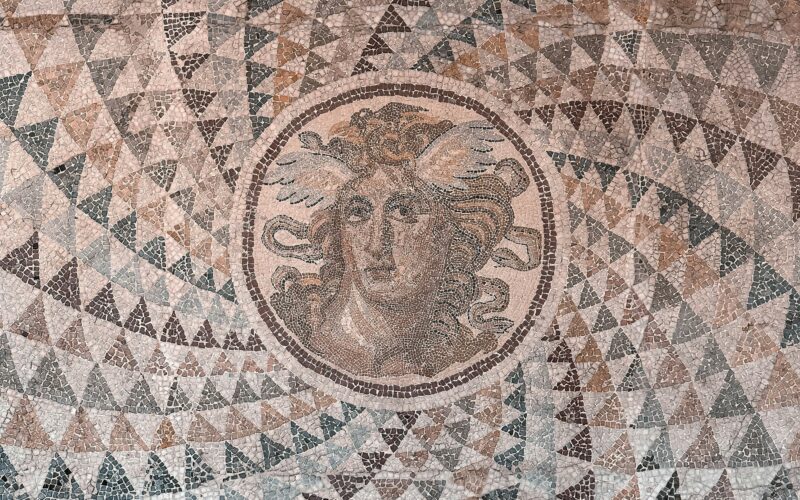
In the rural English countryside, history seems to have a way of remaining buried until the perfect time. For centuries, a series of fields in Rutland, England, near a small village called Ketton, were known for nothing more than their rich soil and quaint ambiance. However, a recent discovery confirmed just last month that has changed the way we think about Roman history forever. What was believed to be nothing more than a tribute to Homer’s epic poem “The Iliad” has been revealed to be a rare and colourful mosaic depicting not a tale of honor and glory, as one might expect from a work following the world’s most famous epic poem, but a “lost” Greek tragedy that hasn’t been performed in two thousand years.
This mosaic, first discovered during a lockdown walk in 2020, has been under academic microscope for the last two years, and on February 13, 2026, researchers from the University of Leicester released their final report confirming their theories: this artwork depicts scenes from “Phrygians,” a play by the ancient Greek playwright Aeschylus. While Homer’s work focused on the wrath of Achilles, this play—and this artwork—focuses on the dark and heavy negotiations surrounding the body of the fallen prince of Troy, Hector. The central image of this work is a scene not commonly depicted in Roman artwork: Hector’s body being weighed in gold, a unique feature of this play by Aeschylus that points to a darker side of war not commonly discussed in “heroic” tales of ancient conflict.
This discovery represents a paradigm shift for archaeologists who have long considered Roman Britain to be a bit of a rough and tumble backwater. This very specific and niche reference to the world of classical literature implies not only that the owner of the villa was not simply wealthy, but also a member of the cosmopolitan elite with a very deep and sophisticated knowledge of classical Greek drama. It serves as a bridge to connect the world of the villa, nestled deep in the English countryside, to the world of the great intellectual centres of the Mediterranean.
Furthermore, aside from the very specific and unique reference to the world of classical literature, the very skill and craftsmanship of the mosaic, when viewed through the capabilities of 2026-grade imaging technology, demonstrates a very surprising level of networking and the exchange of artistic ideas across the world. Indeed, not only did the very story of the world of classical Greek drama travel to the English countryside, but the very specific and unique way of telling the story, through the use of the visual arts, was also exported from the Sahara to the English Midlands, from North Africa to modern-day Turkey.
As the site continues to preserve these stones for another two thousand years, the “Rutland Achilles” stands as a reminder that the past is never past. We think of the past as a closed book, but occasionally, a farmer’s field or a lockdown walk provides a glimpse into a forgotten scene. With the Ketton mosaic, we have gotten a front-row seat to a tragedy we thought was lost to the past, and the reminder that the Romans who lived in our land were much more like us—connected, cultured, and loving a good story—than we have ever dared to believe.