

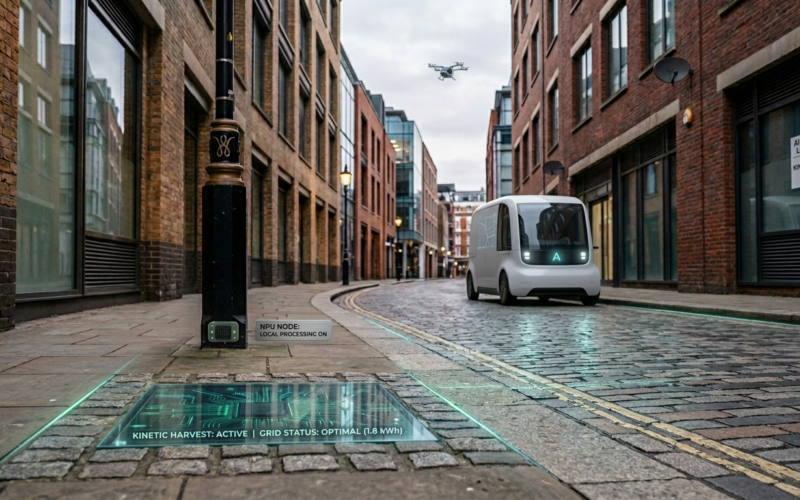
The previous decade was marked by a high focus on innovation in the traditional sense, where the primary concern was attracting public attention with a groundbreaking product, whether it was an unfolding screen, a drone delivery service, or a machine learning algorithm capable of writing poetry. However, the most relevant technological innovations of 2026 will not try to catch people’s eye; they will try to disappear into the background.
Meet the era of “ambient technology,” where the most impressive features will not require active use but rather blend seamlessly into the background.
From chatbots to agents
The key difference between agents and previous generations of artificial intelligence is that while the former are still being developed by programmers, the latter are expected to become autonomous beings who will perform tasks according to what they consider appropriate.
- The Feature: Background Reasoning.
- The Impact: As opposed to a simple reminder in the form of an alert, your AI agent can anticipate your upcoming schedule by drafting a brief for the following meeting, rescheduling all of your other appointments, and making sure there is some time to take a shower after a particularly busy day. Agents become a part of people’s workflows instead of mere tools.
Physical AI
Over the past few decades, people have been talking about “cloud computing” without considering the physical side of technological development; however, in 2026, tech products will get bodies. In terms of artificial intelligence, the key feature of this year is the integration of Large Behavior Models (LBMs) into robotics.
- The Feature: Zero-Shot Generalization in Robotics.
- The Impact: The year 2026 is witnessing the rise of “humanoid assistants” which, unlike previous models, do not require to be programmed for particular locations since they can independently adjust themselves to their environment and even intuitively perceive objects and obstacles. Both factory “cobots” and delivery robots will become more efficient as they will begin thinking on their own.
Hyper-Local Intelligence (“the cloud diet”)
With growing privacy issues and data center bottlenecks becoming increasingly apparent, the most relevant hardware feature of 2026 is high-performance on-device processing.
- The Feature: Integration of neural processing units (NPUs).
- The Impact: No longer would one need to transfer data from one’s smartphone or watch to a server located somewhere in Virginia; by performing all operations on the spot, devices will be more efficient and allow users to remain completely off-line. Moreover, they will prevent one’s private information from being collected and analyzed by unknown parties. This is the de-clouding of life.
Urban symbiosis – the “Life Weaver” city
Finally, cities like Los Angeles and Seoul have been actively implementing technologies which enable them to operate similarly to organisms and not merely pieces of construction.
- The Feature: Kinetic Energy Harvesting & AI-driven Grid.
- The Impact: Several transportation centers of 2026 already boast the installation of special surfaces which will harvest energy from the steps made by commuters. Furthermore, “self-healing networks” will use machine learning to manage data flow and reroute energy and traffic in milliseconds to prevent massive blackouts.
As can be observed, the most relevant innovations in 2026 have nothing to do with impressing customers. In fact, it might be said that the most relevant feature of 2026 is the absence of the traditional user interface and transition to “background mode.”
People are no longer living in the future due to the existence of hover cars; the future has arrived simply because people have stopped noticing its presence around.