

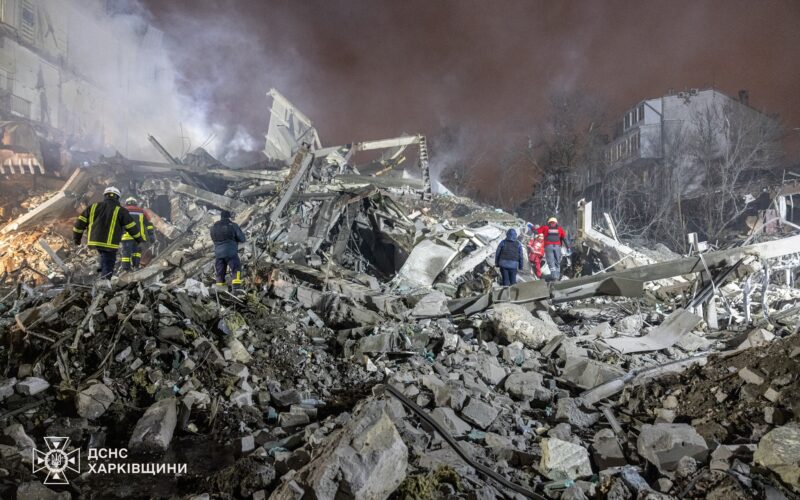
The conflict between Russia and Ukraine reached a fresh peak of intensity on Saturday, April 4, 2026, as a massive wave of drone attacks swept across Ukrainian territory, leaving at least five people dead and thirty others injured. According to comprehensive reports from The Washington Post, The Independent, and The Kyiv Independent, the overnight assault involved nearly three hundred unmanned aerial vehicles, marking one of the most significant aerial bombardments in recent weeks. This surge in military activity occurred against a backdrop of high-stakes diplomacy, as Ukrainian President Volodymyr Zelenskyy traveled to Istanbul for critical negotiations with Turkish President Recep Tayyip Erdogan.
The Ukrainian Air Force issued a formal statement confirming that Russian forces launched a total of 286 drones overnight. While Ukrainian air defense systems were remarkably active, successfully intercepting and downing 260 of the incoming craft, the remaining drones caused devastating impact in several regions. As detailed by The Washington Post, the most tragic losses occurred in the city of Nikopol, located within the Dnipropetrovsk region. Local officials, including regional military administration head Oleksandr Hanzha, confirmed that five individuals—comprising three women and two men—were killed when drones struck a commercial area, damaging several shop buildings and market stalls. An additional nineteen people in Nikopol sustained injuries, including a fourteen-year-old girl.
The Independent provided further context on the geographic breadth of the strikes, noting that the northeastern city of Sumy, situated near the Russian border, was also heavily targeted. In Sumy, the National Police reported that eleven people were wounded, including a fifteen-year-old, as drones impacted residential neighborhoods. The strikes in this region caused extensive damage to private homes, civilian vehicles, and essential utility networks. Emergency responders were seen working through the early morning hours to extinguish fires in residential high-rises, with some loitering munitions reportedly hitting the upper floors of a sixteen-story apartment building in the city center.
In the capital city of Kyiv, the alarm was raised around 6:30 a.m. local time as air-raid sirens echoed throughout the metropolitan area. The Kyiv Independent reported that falling debris from intercepted drones caused a fire on the first floor of a three-story office and warehouse building in the Darnytskyi district. While the structural damage was significant, city authorities, including Mayor Vitali Klitschko, confirmed that no casualties were reported in the capital.The incident highlighted the persistent threat to Kyiv’s infrastructure, even as the city’s sophisticated defense umbrella continues to neutralize the majority of incoming threats.
The Russian Defense Ministry addressed the operation in a statement on Saturday, claiming that its forces utilized long-range precision weapons and strike drones to target military-industrial and energy facilities utilized by the Ukrainian Armed Forces. According to reports from the Anadolu Agency, Russia also accused Ukraine of launching its own retaliatory drone strikes. The Russian ministry claimed to have shot down eighty-five Ukrainian drones over nine different Russian regions, including the annexed Crimea. These counter-strikes reportedly resulted in at least one death and four injuries in Russia’s Rostov region, where a fire broke out at a logistics warehouse and a foreign-flagged commercial vessel was damaged in the Taganrog Bay.
While the skies over Ukraine were filled with fire and debris, the diplomatic corridors of Istanbul were the site of intense discussion. President Zelenskyy’s visit to Turkey comes at what many analysts describe as a critical juncture for regional security. Reports from the Anadolu Agency and European Pravda indicate that the talks between Zelenskyy and Erdogan were expected to cover maritime security in the Black Sea and the possibility of a ceasefire. The visit was preceded by a phone call between President Erdogan and Russian President Vladimir Putin, during which the leaders discussed coordinated measures to ensure the safety of energy infrastructure, such as the TurkStream gas pipeline.
The timing of this escalation is particularly poignant, as it coincides with recent proposals for an Easter ceasefire. As reported by The Kyiv Independent, President Zelenskyy recently discussed the possibility of a temporary halt in hostilities during a call with the Pope. However, Zelenskyy noted that instead of a silence in the skies, the region has seen an escalation in attacks. The ongoing surge in drone deployments is reflected in recent data; according to calculations by the Kyiv Independent, Moscow has deployed over 15,800 drones in the first three months of 2026, representing a nearly 50 percent increase compared to the same period last year.
As emergency services continue to clear debris and assess the full extent of the damage across Nikopol, Sumy, and Kyiv, the international community remains focused on the outcome of the Istanbul summit. The synergy of military pressure and diplomatic maneuvering continues to define the current phase of the war. With both sides now utilizing high-cadence drone warfare at an unprecedented scale, the humanitarian toll on civilian centers remains a primary concern for local leaders and global observers alike. The blueprint for the coming months will likely be shaped by whether the discussions in Turkey can provide a path toward de-escalation or if the trend of intensified aerial campaigns will continue to dominate the landscape of Eastern Europe.