

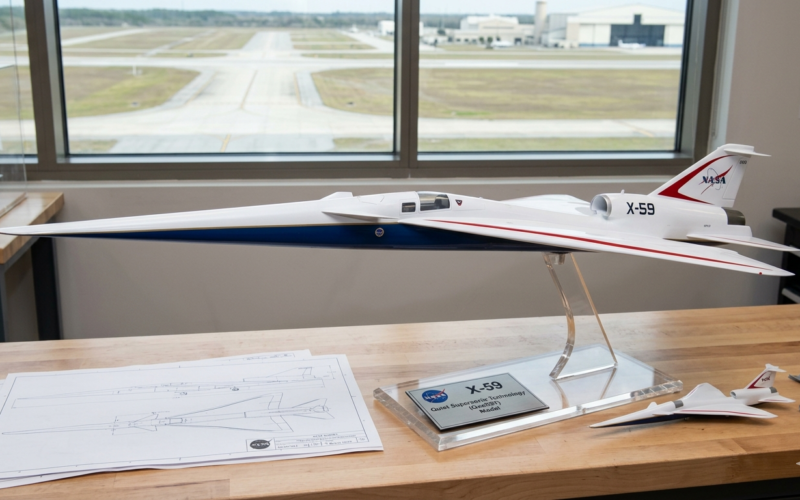
Commercial supersonic flight was banned over land since 1973 due to a very loud noise generated when breaking the sound barrier (or the “sound barrier”). It made commercial supersonic flight socially unacceptable. Until 2026, the dream seemed unreachable – until it became quieter.
Since late March 2026, NASA’s experimental X-59 QueSST (“Quiet SuperSonic Technology”) conducted a number of test flights proving viability of quiet overland supersonic flight. The fourth major flight took place on March 27, 2026 and reached altitudes of 20,000 feet. As a result, the unique aerodynamics of the aircraft proved effective in making supersonic flight socially acceptable.
X-59 is a 30 metre-long puzzle created to eliminate merging shockwaves before they reach the ground.
- Extremely Long and Slender Nose: In this case, it is about one-third of the entire aircraft.
- Top-Mounted Engine Intake: This design makes the shockwaves produced by the engine point upwards.
- No Forward Window: To preserve the exact aerodynamic profile, the pilot sees using the External Vision System (XVS), which consists of a high-resolution monitor providing a full 3D picture of the sky ahead.
This way, a “thump” that will be heard instead of the usual bang should be reduced to 75 decibels, which means something like hearing a closed car door shut down the street.
What Does It Mean for Our Industry?
As NASA proves that the noise created by the X-59 is negligible, there might be a chance that the FAA and other international authorities could reconsider the current ban on overland supersonic flight. If so, then new generations of airliners, like those manufactured by Boom Supersonic, could enter the market and shorten flight times between the most distant cities from New York and London to below 3.5 hours.
While the X-59 is the focus of the public attention with its unprecedented performance capabilities, the whole industry is currently dealing with two other major shifts:
- Agentic AI and Air Traffic Management: 2026 saw AI advancing into a new level called agentic AI. At the moment, it is used by Air Traffic Management to perform irregular operations in a fully autonomous manner and without any flight delays caused by it.
- SAF Takeover: Finally, the industry got rid of Sustainable Aviation Fuels (SAFs) as “green dreams”. Instead, as mandated this year, airlines sign off-take agreements to ensure steady supply of the fuel to meet the 2050 targets.
So, in 2026, we are trying to fly faster than we have ever tried to, leave even less traces behind and make a much quieter sound than we were ever able to.